
MAS101
MAS101
Exclusively for IIT students graduating in 2027: Unlock role-focused skill pathways across Engineering, Data Science, Analytics, Product, and Consulting to accelerate placement readiness.
Apply NowOur Numbers over the years
Check your campus placement readiness
1 of 7 steps
Readiness Score
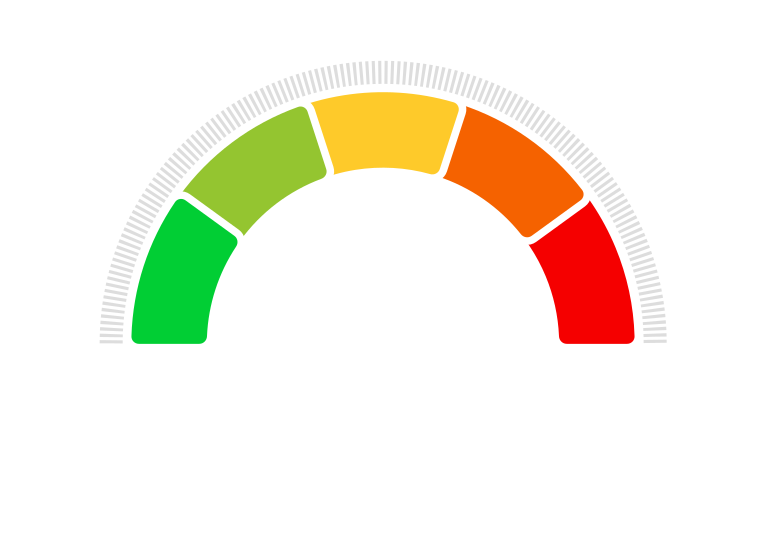

Medium
Based on your background, skills, and time availability
Your profile matches early-stage candidates who typically convert with focused SQL practice and one strong project.
Improvement Projection
Your profile matches early-stage candidates who typically convert with focused SQL practice and one strong project.
Recommendations
Focus next 4 weeks on SQL + analytics project
Structured guidance is recommended due to your timeline
Designed to Take Students from Classroom to Career
Learn concepts, practise with real assessments, and get guided by industry mentors — all in one journey.
MR Mentor
Get interview-ready with MR Mentor
1:1 resume reviews, mock interviews, and industry feedback.
MR Learn
Learn with MR Learn
Structured skill clusters with IIT-friendly pace and live doubt support.
MR Test
Prove your skills with MR Test
Role-based tests, clear scorecards, and badges that unlock job eligibility.
MR Hire
Access opportunities via MR Hire
High-readiness profiles are shared with off-campus hiring partners.
Course Timeline
SDE
Functional Track
DS & AI
Weeks 1–2
Computational Thinking
Problem decomposition
Flowcharts & pseudocode
Time & space complexity
Big-O analysis
Pattern recognition
Weeks 3–4
Clean Coding & Language Basics
Git & GitHub workflows
Linux basics
IDE + debugging
OOP fundamentals
Coding standards & modularity
Weeks 5–6
Core Data Structures I
Arrays & strings
Two pointers
Sliding window
Linked lists
Stacks & queues
Weeks 7–8
Core Data Structures II
Binary trees
BST
Heaps
Binary search
Weeks 9–10
Advanced DSA I
Hashing
Graphs (BFS/DFS)
Union-Find
Tries
Weeks 11–12
Advanced DSA II
Dynamic Programming
Memoization
Tabulation
Core DP patterns
Weeks 13–14
Backend Development
REST APIs
MVC architecture
Authentication (JWT)
API versioning
OpenAPI
Weeks 15–16
Databases
SQL modeling
Indexing
Query optimization
Transactions
Redis basics
Weeks 17–18
Frontend Fundamentals
HTML5 & CSS3
Responsive design
Accessibility fundamentals
Weeks 19–20
Full Stack Development
ES6+
TypeScript basics
React (Hooks, state management)
API integration
Weeks 21–22
Core System Design
Scalability fundamentals
Load estimation
Caching strategies
Sharding (intro)
Basic distributed systems concepts
Design case studies (URL shortener, chat system)
Weeks 23–24
AWS & Deployment
AWS EC2
S3
RDS
IAM fundamentals
Docker (basics)
CI/CD pipelines
Application monitoring basics
Weeks 25–26
GenAI Foundations & LLM Integration
Transformer basics (conceptual)
Prompt engineering techniques
OpenAI / Anthropic API integration
Streaming responses
Function calling
Embeddings & Vector databases
Chunking strategies
Retrieval pipelines (RAG)
Week 27
Agentic AI & Memory Systems
Planner–Executor pattern
Tool-using agents
Multi-step reasoning workflows
API tool chaining
Short-term vs long-term memory
Conversation state handling
Vector memory stores
Week 28
LLM Infrastructure & Inference
Hosted APIs vs self-hosted models
GPU basics
Tokenization & cost optimization
Model selection strategies
Hugging Face Transformers
Quantization (intro)
Batch vs real-time inference
Latency optimization
Prompt injection risks
Output validation
Human-in-the-loop systems
Why Choose MAS?

Build ATS Resumes
AI analysis + expert 1:1 builds ATS-beating resumes with 25+ projects.

Ace Company Tests
10k+ questions + 50 company mocks identify your exact weaknesses.

Secure Dream Jobs
No fee till 7+ LPA via 1000+ alumni network + hiring partners.

Nail Interviews
500+ DA/DS questions + 100+ mentors for mock interviews.

Proven Results
86% above 12 LPA | 18 LPA average | 34 LPA highest (16 IITians).
Our Alumni's Triumph
Frequently Asked Questions
Everything you need to make a confident decision. Our mentors respond within 2 hours — no sales pitch, just honest answers.
What types of programs does MAS offer? How are they different from each other?
MAS offers three distinct program types. Placement Cohorts (MAS 101 & MAS 102) are intensive programs for final-year students targeting top placements — with Pay After Placement or subsidised fees. Career Accelerator courses (6-month and 12-month) are open to students and professionals looking to build deep domain expertise with guaranteed or supported placement outcomes. Career Capsules are short, focused modules (20–100 hours) for targeted upskilling in specific tools or domains. Each type differs in duration, eligibility, payment model, and depth of placement support.
What is the difference between MAS 101 and MAS 102?
Both MAS 101 and MAS 102 are placement cohorts for students graduating in 2027, but they differ in scope. MAS 101 is exclusively for IIT students (Pan-IIT), runs for 6 months, and follows a Pay After Placement model. MAS 102 is open to students from any institution, runs for 12 months, and is priced differently. Both programs offer structured mentorship, mock interviews, and active hiring-partner connections, but MAS 102 provides a longer runway for skill building.
What are Career Accelerator courses and how do the 6-month and 12-month tracks differ?
Career Accelerator courses are designed for students or working professionals who want to build deep expertise and break into a high-growth domain. The 6-month track focuses on skill advancement, project portfolio building, and profile development — ideal if you already have foundational knowledge. The 12-month track is the flagship offering: it includes everything in the 6-month track plus guaranteed placement support, extended mentorship, and access to the full Mr. Hire deployment platform. Only the 12-month track carries a job guarantee.
What are Career Capsules? Are they worth it if I'm already enrolled in a bootcamp?
Career Capsules are short, focused learning modules — 20 to 100 hours of curated content delivered over 4 weeks to 4 months. Domain Capsules offer deep dives into specific topics (SQL for Analytics, Python for Data Science, Power BI, GenAI). Tool Capsules focus on mastering a single tool end-to-end. If you're already in a bootcamp, Capsules can complement your learning by filling specific skill gaps or adding a specialisation that strengthens your profile for niche roles.
Will I get a certificate after completing a MAS program?
Yes. Every MAS program — cohort, bootcamp, or capsule — includes an industry-recognised completion certificate issued by My Analytics School and co-validated by our IIT alumni network. For Placement Cohort and Career Accelerator students, you additionally receive a Placement-Ready Badge on the Mr. Hire platform, visible to our 250+ hiring partners when they search for candidates.
How long do I have access to course material after enrollment?
Access depends on the program. The 12-month Career Accelerator includes lifetime access to recorded content via Mr. Learn, along with extended access to updated material. The 6-month Career Accelerator provides access for the duration of the program plus a post-completion period. Placement Cohort students (MAS 101/102) retain access through the full cohort duration. Career Capsule access is limited to the module duration with the option to revisit for a defined period.
How much do MAS programs cost?
Career Capsules range from ₹5,000–₹20,000 (upfront, per capsule). Career Accelerator 6-month costs ₹60,000–₹80,000 (upfront or EMI). Career Accelerator 12-month (Job-Guaranteed) costs ₹1,20,000–₹1,60,000, available via EMI or Income Share Agreement. Placement Cohorts (MAS 101/102) use a Pay After Placement model with only a small registration fee upfront. Full pricing is available on individual course pages.
What does "Pay After Placement" actually mean? Is there anything I need to pay upfront?
Pay After Placement means you only pay the full program fee after you receive and accept a job offer — the program only earns when you earn. A non-refundable registration fee is collected at enrollment (typically ₹2,000–₹5,000) to secure your cohort seat, and is deducted from your total fee upon placement. There is no large upfront cost, no EMI burden during your program, and no payment obligation if you are not placed.
Are EMI or installment payment options available?
Yes. MAS offers no-cost EMI plans on 3, 6, and 12-month tenures for major credit and debit cards. An Income Share Agreement (ISA) option is also available for the 12-month Career Accelerator — you pay a percentage of your post-placement salary for a fixed period rather than paying upfront. Scholarship and fee-waiver slots are available for high-potential students on a case-by-case basis.
What is the refund policy if I change my mind after enrolling?
Within 7 days of enrollment: full refund (excluding payment processing charges). After 7 days but before the program starts: 50% refund. After the program starts: no refund. For Pay After Placement programs, the registration fee is non-refundable, but since no large fee is collected upfront, there is no additional financial exposure. ISA agreements have their own cancellation terms outlined in the agreement document.
Which companies hire MAS students? What roles can I realistically target?
MAS has placed 800+ students across 250+ companies, including Google, Microsoft, Amazon, J.P. Morgan, Morgan Stanley, McKinsey, Bain, BCG, Deloitte, EY, PwC, Accenture, KPMG, HSBC, Citibank, Flipkart, Paytm, Meesho, OLA, PhonePe, and Fractal. Typical roles include Data Analyst, Business Analyst, Data Scientist, Product Analyst, BI Developer, ML Engineer, Strategy Consultant, and Product Manager — with packages ranging from ₹8 LPA to ₹35+ LPA.
Is placement guaranteed? What actually happens after I complete the program?
The 12-month Career Accelerator includes a Guaranteed Placement offering. For all other programs, MAS provides structured placement support: a dedicated Placement Manager, mock interviews with IIT alumni, direct referrals to hiring partners, resume and LinkedIn optimisation, and priority listing on Mr. Hire. The guarantee on the 12-month track means MAS continues supporting you until you land an offer — with defined terms in your enrollment agreement.
How quickly do MAS students typically get placed after completing the program?
For students who actively engage — mock interviews, application drives, and Mr. Hire profile completion — most receive their first offer within 4 to 8 weeks post-program. MAS's Mr. Hire platform enables talent deployment in under 7 days for enterprise clients. Timelines vary based on target role, location, and market conditions, but MAS's structured pipeline significantly reduces the typical job-search duration.
What kind of mentorship and support will I receive throughout the program?
MAS delivers layered support through the Mr. Mentor platform: 1-on-1 IIT alumni mentorship sessions (matched to your target role), weekly live cohort sessions with domain experts, dedicated doubt-clearing sessions, a peer learning community, a personal Placement Manager, resume and LinkedIn reviews, and mock interview panels with hiring professionals. Career Accelerator and Placement Cohort students receive priority access to all support tiers.
Who are the MAS mentors? Are they actually from IITs?
Yes — MAS has a network of 1,000+ IIT alumni mentors currently working at Google, Microsoft, McKinsey, Goldman Sachs, Morgan Stanley, Fractal, and top-growth startups. MAS was co-founded by IIT BHU alumnus Sajan Tonge (Founder & CEO) and IIT Madras alumnus Kumar Gaurav. Mentors are matched to students based on domain expertise and target industry, with structured session templates and feedback loops.
Are there any prerequisites for joining MAS programs?
Prerequisites vary by program. MAS 101 requires you to be a final-year IIT student (2027 batch) — no coding background is mandatory, but basic familiarity is helpful. MAS 102 is open to final-year students from any institution. Career Accelerator courses require basic analytical thinking; the 12-month track is suitable even for beginners. Career Capsules have no formal prerequisites. In general, a willingness to put in consistent effort matters more than prior qualifications.
I'm not from an IIT. Can I still benefit from MAS?
Absolutely. MAS 101 is specifically for IIT students, but every other program — MAS 102, all Career Accelerators, and all Capsules — is open to students and professionals from any institution across India. MAS has trained learners from NITs, BITS, IIITs, DU, and hundreds of Tier 2 and Tier 3 colleges. Hiring partners evaluate candidates on competence demonstrated through projects and assessments, not institution name.
I'm a working professional, not a student. Are MAS programs suitable for me?
Yes. The Career Accelerator (6-month and 12-month) programs and all Capsule courses are designed to accommodate working professionals with flexible batch timings and self-paced module access. If you're targeting a lateral move into Data, AI, Product, or Consulting — Mr. Hire directly connects you with companies actively hiring experienced professionals. Many MAS alumni have transitioned from non-tech backgrounds with 40–100% salary increases.
Is MAS fully online? Can I join from any city in India?
Until 2026, MAS has been a fully digital platform — live cohort sessions, mentorship, mock interviews, and placement drives are all conducted online. You can join from anywhere in India without relocating. MAS is expanding into physical learning centres in select cities starting 2026, but the online experience will remain the primary and full-featured mode. All content is accessible via Mr. Learn, Mr. Mentor, and Mr. Hire.
What skill domains does MAS cover across its programs?
MAS programs are organised around 9 skill clusters: (1) Data Analytics & BI — SQL, Power BI, Tableau, Excel; (2) Data Science & Statistics — Python, R, statistical modelling; (3) AI & Machine Learning — ML algorithms, NLP, computer vision; (4) Generative AI & LLMs — prompt engineering, RAG, fine-tuning; (5) Product Management — roadmapping, PRDs, user research; (6) Strategy & Consulting — frameworks, case-solving; (7) Finance & Quant — derivatives, risk modelling; (8) Digital Marketing Analytics; (9) Cloud & Data Engineering — dbt, Spark, Airflow.
Which skill domain is best suited for me based on my background?
Strong in Maths/Statistics → Data Science or AI & ML. Enjoy data with business context → Data Analytics & BI or Strategy & Consulting. Interested in building products → Product Management. Finance background → Finance & Quant. Like building data infrastructure → Cloud & Data Engineering. If unsure, our free mentorship call with an IIT alumni mentor can map your strengths to the right domain within 30 minutes.
Still have questions? Chat with a mentor on WhatsApp